
Football Special Teams: How to Block Field Goals and PATs
Blocking either a PAT or a field goal attempt in a football game can change the momentum of that game and eventually decide its outcome. To block kicks, defensive players must be dedicated, athletic, and willing to physically sacrifice themselves for the good of the team. To have a successful block, each man must do his job.
Blocked kicks may appear easy, but a play such as the middle field goal block requires talented defensive linemen who can win the battle up front. These defensive linemen position themselves near the center snapping the ball because the quickest way to any field goal or extra point attempt is up the middle.
With the ball 7 yards off the line of scrimmage, teams place their best pass-rushers in the middle, believing that one of them can penetrate the blocking line a couple of yards and then raise his arms, hoping to tip the booted ball with his hands. If the kicker doesn’t get the proper trajectory, the kick can be blocked.
In the following figure, the three interior defensive linemen (LT, N, and RT) are over the two guards and the snapper:
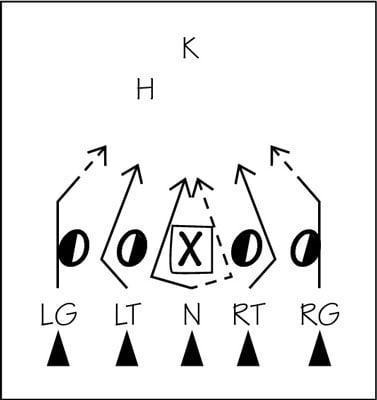
RT must align on the inside shoulder of the guard opposite him.
N lines up directly across from the center.
LT aligns on the inside shoulder of the guard opposite him.
These linemen want to be able to gain an edge, an angle, on those blockers. Their attempts to block the kick won’t work if the two tackles align squarely on top of the guards. They must pick a particular shoulder of the guard and attack to that side.
The guards’ role in the play is crucial:
Both LG and RG (left and right guard) drive through the tackles’ outside shoulders.
Their objective is to apply enough individual pressure so as not to allow the tackle to slide down the line and help his buddies inside.
Both players attempt to block the kick if they break free.
If not, they contain the opponent’s linemen in case of a fake field goal attempt. Containing means to hold their ground and simply jostle with the players who are blocking them — all while keeping their eyes on the kicker and holder.
The only chance that the middle block has of succeeding is if the pass-rush moves that the three interior defensive linemen make on the offensive linemen work. It’s critical that all three players are isolated on one blocker. The defenders can decide to double-team a blocker, hoping one of them breaks free and penetrates the line.
On other kick-block plays, teams attempt to break through from the outside, using two men on one blocker and hoping the single blocker makes the wrong choice and allows the inside rusher to get free.

Football Glossary
ACC
The Atlantic Coast Conference of college football teams.

Football Glossary
AFC
An acronym for the American Football Conference.

Football Glossary
AFL
An acronym for the American Football League.

Football Glossary
BCS
An acronym for the Bowl Championship Series.

Football Glossary
Big Ten
A college athletic conference whose eleven-member institutions are located mainly in the Midwestern United States.

Football Glossary
bye week
A week during which an NFL team doesn’t play; every NFL team has one week of the season off.

Football Glossary
center
The player who snaps the ball to the quarterback. A center handles the ball on every play.

Football Glossary
DEF
An acronym for Team Defense.

Football Glossary
fullback
A player who’s responsible for blocking for the running back and also for pass-blocking to protect the quarterback. Fullbacks, who are generally bigger than running backs, are short-yardage runners.

Football Glossary
kicker; placekicker
The member of the special team who is responsible for field goal and extra point attempts.

Football Glossary
NCAA
An acronym for the National Collegiate Athletic Association.

Football Glossary
NFC
An acronym for the National Football Conference.

Football Glossary
NFL
An acronym for the National Football League.

Football Glossary
Pac-10
The Pacific-10 Conference is a college athletic conference that operates in the western United States.

Football Glossary
Punt
A kick to the opponent without the use of a tee.

Football Glossary
quarterback
The leader of the team. The quarterback calls the plays in the huddle, yells the signals at the line of scrimmage, and then receives the ball from the center. Then he hands off the ball to a running back, throws it to a receiver, or runs with it.

Football Glossary
running back; tailback; halfback; wingback
A player who runs with the football.

Football Glossary
SEC
The Southeastern Conference of college football teams.

Football Glossary
snake draft
A draft in which each fantasy coach has one pick in each round. Each team makes its first-round pick based on a predetermined order.

Football Glossary
ST
An acronym for Special Teams.

Football Glossary
stud
A top-rated fantasy football starter.

Football Glossary
tight end
A player who serves as a receiver and also as a blocker. The tight end lines up beside the offensive tackle to the right or the left of the quarterback.

Football Glossary
waivers
A situation where a player is dropped from a team roster; the player goes on waivers for a limited time before becoming a free agent. All coaches then have a set amount of time (usually two days) to decide whether to add him to their teams.

Football Glossary
wide receiver
A player who uses his speed to elude defenders and catch the football. Teams use as many as two to four wide receivers on every play.