
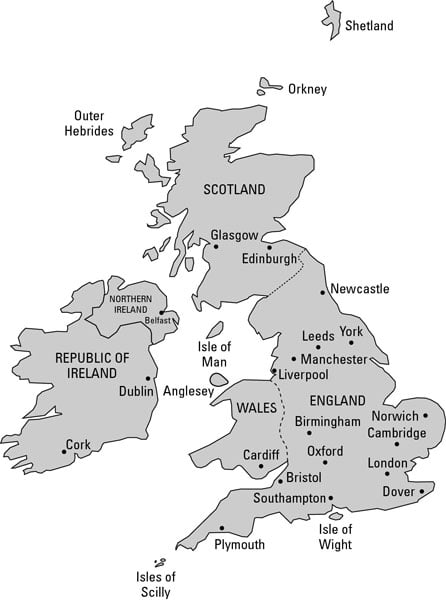
The British Isles: the lie of the land
The islands of Britain and Ireland are normally referred to as ‘the British Isles’ – not a politically accurate term (Ireland is not ‘British’) but no-one has yet come up with a workable alternative.
The historical periods of Britain
The history of Britain is usually divided by historians into a series of periods. This list gives you some of the highlights of each period.
Ancient Britain
-
Neolithic Britain c12,000 BC–c2,750 BC
-
The Beaker people and the Bronze Age c2,750 BC–750 BC
-
Iron Age and La Tène culture c750 BC–43 AD
-
Roman Britain 43 AD–410
The Middle Ages
-
Anglo–Saxon raids and settlement 449–c550
-
Separate Anglo–Saxon Kingdoms c550–924
-
Anglo–Saxon England united 924–1066
-
Danish rule 1016–1042
-
Norman period 1066–1154
-
The Anarchy 1135–1148
-
The Plantagenets 1154–1399
-
Conquest of Ireland begins 1155
-
Scottish Wars of Independence 1296–1357
-
Hundred Years War with France 1337–1453
-
Wars of the Roses 1455–1485
Early Modern Britain
-
Tudor period 1485–1603
-
English Reformation begins 1532
-
Union of Crowns of England and Scotland 1603
-
Expansion into America begins 1620
-
Civil Wars and Revolution 1642–1660
-
Royal Society incorporated 1662
-
Revolution Settlement 1688–9 and Union of England and Scotland 1707 create basis of modern British state
The Modern Age
-
Changes in agriculture begin 1730s
-
Beginnings of industrialization 1770s–1780s
-
Wars in America and with France help to unify British state 1770s–1815
-
Victorian Age 1837–1901
-
Great Exhibition marks highpoint of Victorian era 1851
-
Imperial expansion in Africa 1880s–1890s
-
Great War 1914–1918
-
Second World War 1939–1945
-
Height of industrial unrest 1960s–1980s
-
Britain within the European Union 1970s–2000s
Rulers of England 924–1603
The first king acknowledged as king of all England was the Saxon King of Wessex, Athelstan, who came to the throne in 924. Later, Edward I brought Wales under English rule and Henry VIII incorporated it into England. Elizabeth I, who died in 1603, was the last ruler of England not to rule Scotland as well.
House of Wessex
-
Athelstan 924–939
-
Edmund I 939–946
-
Edred 946–955
-
Edwy ‘the Fair’ 955–959
-
Edgar ‘the Peaceful’ 959–975
-
Edward ‘the Martyr’ 975–978
-
Ethelred II ‘the Unredy’ 978–1016
Danish Usurpation
-
Sweyn Forkbeard 1014
House of Wessex
-
Edmund II ‘Ironside’ 1016
Danes
-
Cnut (Canute) 1016–1035
-
Harald I ‘Harefoot’ 1035–1037 (regent); 1037–1040 (king)
-
Cnut II (Harthacnut) 1040–1042
House of Wessex
-
Edward ‘the Confessor’ 1042–1066
-
Harold II Godwinsson 1066
Normans
-
William I ‘the Conqueror’ 1066–1087
-
William II ‘Rufus’ 1087–1100
-
Henry I ‘Beauclerc’ 1100–1135
-
Stephen 1135–1154
Angevins–Plantagenets
-
Henry II 1154–1189
-
Richard I ‘Coeur de Lion’ 1189–1199
-
John ‘Lackland’ 1199–1216
-
Henry III 1216–1272
-
Edward I 1272–1307
-
Edward II 1307–1327
-
Edward III 1327–1377
-
Richard II 1377–1399
House of Lancaster
-
Henry IV 1399–1413
-
Henry V 1413–1422
-
Henry VI 1422–1461
House of York
-
Edward IV 1461–1483
-
Edward V 1483
-
Richard III 1483–1485
Tudors
-
Henry VII 1485–1509
-
Henry VIII 1509–1547
-
Edward VI 1547–1553
-
Lady Jane Grey 1553
-
Mary I 1553–1558
-
Elizabeth I 1558–1603
Rulers of Scotland 843–1625
The first king who is generally regarded as having ruled over all of Scotland was Kenneth MacAlpin, who had managed to conquer both the Picts and the Scots by 842. No-one knows exactly when he was declared king, so 843 is an approximation. All the kings of Scotland until the thirteenth century were descended from Kenneth MacAlpin whether through the male or female line, though different branches of the royal house were often deadly rivals for the throne.
The last king of a separate Scotland was James VI, who died in 1625. In 1603, he also became King of England as King James I.
House of MacAlpin
-
Kenneth MacAlpin c.843–c.858
-
Donald I 859–862
-
Constantine I 862–876
Interregnum
-
Interregnum – no overall king 876–877
House of MacAlpin
-
Aed c.877–878
-
Eochaid 878–889 and Giric 878–889 (probably shared the throne)
-
Donald II 889–900
-
Constantine II 900–c.943
-
Malcolm I MacDonald c.943–954
-
Indulf 954–962
-
Dubh ‘the Black’ 962–966
-
Culen 966–971
-
Kenneth II 971–995
-
Constantine III ‘the Bald’ 995–997
-
Kenneth III 997–1005
-
Malcolm II 1005–1034
-
Duncan I 1034–1040
House of Moray
-
Macbeth 1040–1057
-
Lulach 1057–1058
House of MacAlpin
-
Malcolm III Canmore 1058–1093
-
Donald III Bane 1093–1094
-
Duncan II 1094
-
Donald III Bane 1094–1097 (resumed the throne)
-
Edgar 1097–1107
-
Alexander I 1107–1124
-
David I 1124–1153
-
Malcolm IV ‘the Maiden’ 1153–1165
-
William ‘the Lion’ 1165–1214
-
Alexander II 1214–1249
-
Alexander III 1249–1286
-
Margaret, ‘the Maid of Norway’ 1286–1290
Interregnum
-
English overlordship (Edward I) 1290–1292
House of MacAlpin
-
John Balliol 1292–1296 (abdicated)
English invasion and Occupation
-
Edward I of England 1296–1306
House of Bruce
-
Robert I de Brus (Bruce) 1306–1329
-
David II 1329–1371
House of Stewart
-
Robert II ‘the Steward’ 1371–1390
-
Robert III (John Stewart) 1390–1406
-
James I 1406–1437
-
James II 1437–1460
-
James III 1460–1488
-
James IV 1488–1513
-
James V 1513–1542
-
Mary, Queen of Scots 1542–1567
-
James VI 1567–1625 (became James I of England, 1603)
Rulers of England and Scotland 1603–1707
King James VI of Scotland inherited the throne of England in 1603. Although this is called ‘the Union of the Crowns’, in fact the crowns of England and Scotland remained separate until the Act and Treaty of Union of 1707 joined them in the new Kingdom of Great Britain.
House of Stuart
-
James I (James VI of Scotland) 1603–1625
-
Charles I 1625–1649
Commonwealth and Protectorate
-
Commonwealth (Republic) 1649–1654
-
Oliver Cromwell 1654–1658 (Lord Protector)
-
Richard Cromwell 1658–1659 (Lord Protector)
-
Commonwealth (Republic) 1659–1660
House of Stuart
-
Charles II 1660–1685
-
James II (James VII of Scotland) 1685–1688
-
William III and Mary II 1689–1702
-
Anne 1702–1714
Rulers of Great Britain 1707–1801 and the United Kingdom 1801–present
The Act and Treaty of Union of 1707 between the Parliaments of England and Scotland created a Kingdom of Great Britain which consisted of England (which incorporated Wales) and Scotland. In 1801 the Act of Union, passed by the British and Irish Parliaments, created a new United Kingdom of Great Britain and Ireland. After the 1922 Anglo–Irish Treaty this became the United Kingdom of Great Britain and Northern Ireland, the name the country retains to this day.
House of Hanover
-
George I 1714–1727
-
George II 1727–1760
-
George III 1760–1820
-
George IV 1820–1830
-
William IV 1830–1837
House of Saxe–Coburg–Gotha
-
Victoria 1837–1901
-
Edward VII 1901–1910
House of Windsor
-
George V 1910–1936
-
Edward VIII 1936
-
George VI 1936–1952
-
Elizabeth II 1952–
British Prime Ministers 1721–present
The office of Prime (or ‘first’) Minister developed in the eighteenth century, when the First Lord of the Treasury came to be regarded as the official head of the government. The first person who is generally regarded as having acted as Prime Minister was Sir Robert Walpole.
| Sir Robert Walpole | 1721–1742 | Whig |
| Spencer Compton, Earl of Wilmington | 1742–1743 | Whig |
| Henry Pelham | 1743–1754 | Whig |
| Thomas Pelham-Holles, Duke of Newcastle | 1754–1756 | Whig |
| William Cavendish, Duke of Devonshire | 1756–1757 | Whig |
| Thomas Pelham-Holles, Duke of Newcastle | 1757–1762 | Whig |
| John Stuart, Earl of Bute | 1762–1763 | Tory |
| George Grenville | 1763–1765 | Whig |
| Charles Watson-Wentworth, Marquess of Rockingham | 1765–1766 | Whig |
| William Pitt, Earl of Chatham | 1766–1768 | Whig |
| Augustus Fitzroy, Duke of Grafton | 1768–1770 | Whig |
| Frederick North, Lord North | 1770–1782 | Tory |
| Charles Watson-Wentworth, Marquess of Rockingham | 1782 | Whig |
| William Petty-Fitzmaurice, Earl of Shelburne | 1782–1783 | Whig |
| William Cavendish-Bentinck, Duke of Portland | 1783 | Whig–Tory coalition |
| William Pitt (the Younger) | 1783–1801 | Tory |
| Henry Addington1801–1804 | Tory | |
| William Pitt (the Younger) | 1804–1806 | Tory |
| William Wyndham Grenville, Lord Grenville | 1806–1807 | Whig–Tory coalition (The Ministry of All the Talents) |
| William Cavendish-Bentinck, Duke of Portland | 1807–1809 | Tory |
| Spencer Perceval1 | 809–1812 | Tory (assassinated) |
| Robert Jenkinson, Lord Liverpool | 1812–1827 | Tory |
| George Canning | 1827 | Tory |
| Frederick John Robinson, Lord Goderich | 1827–1828 | Tory |
| Arthur Wellesley, Duke of Wellington | 1828–1830 | Tory |
| Charles Grey, Earl Grey | 1830–1834 | Whig |
| William Lamb, Viscount Melbourne | 1834 | Whig |
| Arthur Wellesley, Duke of Wellington | 1834 | Tory |
| Sir Robert Peel | 1834–1835 | Tory–Conservative |
| William Lamb, Viscount Melbourne | 1835–1841 | Whig |
| Sir Robert Peel | 1841–1846 | Tory–Conservative |
| Lord John Russell | 1846–1852 | Whig |
| Edward Smith-Stanley, Earl of Derby | 1852 | Tory–Conservative |
| George Hamilton-Gordon, Earl of Aberdeen | 1852–1855 | Whig |
| Henry John Temple, Viscount Palmerston | 1855–1858 | Whig |
| Edward Smith-Stanley, Earl of Derby | 1858–1859 | Tory–Conservative |
| Henry John Temple, Viscount Palmerston | 1858–1865 | Whig |
| John Russell, Earl Russell | 1865–1866 | Whig–Liberal |
| Edward Smith-Stanley, Earl of Derby | 1866–1868 | Tory–Conservative |
| Benjamin Disraeli | 1868 | Conservative |
| William Ewart Gladstone | 1868–1874 | Liberal |
| Benjamin Disraeli (Earl of Beaconsfield from 1876) | 1874–1880 | Conservative |
| William Ewart Gladstone | 1880–1885 | Liberal |
| Robert Gascoyne-Cecil, Marquess of Salisbury | 1885–1886 | Conservative |
| William Ewart Gladstone | 1886 | Liberal |
| Robert Gascoyne-Cecil, Marquess of Salisbury | 1886–1892 | Conservative |
| William Ewart Gladstone | 1892–1894 | Liberal |
| Archibald Primrose, Earl of Rosebery | 1894–1895 | Liberal |
| Robert Gascoyne-Cecil, Marquess of Salisbury | 1895–1902 | Conservative |
| Arthur Balfour | 1902–1905 | Conservative |
| Sir Henry Campbell-Bannerman | 1905–1908 | Liberal |
| Herbert Henry Asquith | 1908–1916 | Liberal |
| David Lloyd George | 1916–1922 | Liberal–Conservative coalition |
| Andrew Bonar Law | 1922–1923 | Conservative |
| Stanley Baldwin | 1922–1924 | Conservative |
| James Ramsay MacDonald | 1924 | Labour |
| Stanley Baldwin | 1924–1929 | Conservative |
| James Ramsay MacDonald | 1929–1931 | Labour |
| James Ramsay MacDonald | 1931–1935 | National Government (Labour–Conservative–Liberal coalition) |
| Stanley Baldwin | 1935–1937 | National Government (Conservative–Liberal) |
| Neville Chamberlain | 1937–1940 | National Government |
| Winston Spencer Churchill | 1940–1945 | Coalition (Conservative–Labour–Liberal) |
| Clement Attlee | 1945–1951 | Labour |
| Winston Spencer Churchill | 1951–1955 | Conservative |
| Anthony Eden | 1955–1957 | Conservative |
| Harold Macmillan | 1957–1963 | Conservative |
| Sir Alec Douglas-Home | 1963–1964 | Conservative |
| Harold Wilson | 1964–1970 | Labour |
| Edward Heath | 1970–1974 | Conservative |
| Harold Wilson | 1974–1976 | Labour |
| James Callaghan | 1976–1979 | Labour |
| Margaret Thatcher | 1979–1990 | Conservative |
| John Major | 1990–1997 | Conservative |
| Anthony (Tony) Blair | 1997–2007 | Labour |
| Gordon Brown | 2007–2010 | Labour |
| David Cameron | 2010– | Coalition (Conservative–Liberal Democrat) |