
Biology Basics: Ecosystems
Life thrives in every environment on Earth, and each of those environments is its own ecosystem, essentially a little machine made up of living and nonliving parts that interact with one another in a particular environment. An ecosystem can be very large, like the open ocean, or very small, like the ecosystem inside the digestive system of an ant. The living parts of an ecosystem, called biotic factors, are all the organisms that live in the area. The nonliving parts, called abiotic factors, are the nonliving things in the area.
All the living things together in an ecosystem form a community. Within a community, each group of the same kind of organism that lives in the same area at the same time is a population. This figure shows how these levels of organization intersect with one another and with other levels of biological organization.
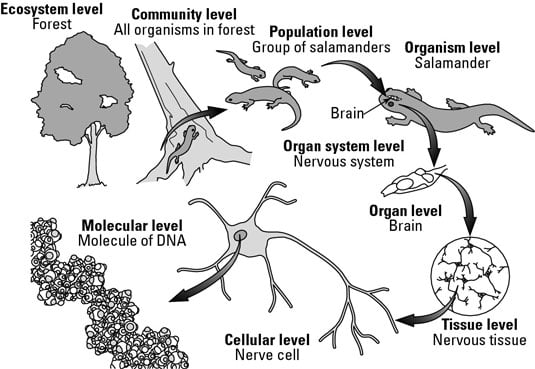
The organization of living things.
Try these questions to see how well you understand basic ecosystem terminology.
For questions 1–3, use the terms that follow to identify which level of biological organization is represented by each scenario.
a. Ecosystem
b. Community
c. Population
Your friend is a beekeeper and has a hive of bees in his backyard. What does the group of bees living in the hive represent?
You go to the beach on a sunny day and walk on the rocks at the edge of the ocean. You see mussels and algae growing on the rocks, and you find small crabs, anemones, and fish in some tide pools. What does this rocky area represent?
In a forest, trees are often inhabited by birds, squirrels, insects, and fungi. What do the living things in the tree represent?
Imagine your backyard or a natural area near your home. Identify the abiotic and biotic factors that exist in this ecosystem.
The following are answers to the practice questions presented.
The answer is c. Population.
The answer is a. Ecosystem.
The rocky intertidal zone contains interconnected biotic and abiotic factors.
The answer is b. Community.
Your answer depends on the environment you chose, but in general, abiotic factors include sun, rocks, air, and water.
Biotic factors include all organisms such as plants, insects, birds, and mammals. Materials such as soil or a pond, which contain both living and nonliving components, can be hard to classify. In those cases, identify what parts are living or nonliving. For example, the minerals that make up soil are abiotic, while the bacteria and fungi that live in soil are biotic.

Biology Glossary
anemia
A low number of red blood cells or low level of hemoglobin; may be caused by dietary deficiencies, metabolic disorders, hereditary conditions, or damaged bone marrow.

Biology Glossary
antigen
A foreign substance in the body that causes an immune response.

Biology Glossary
body mass index
The BMI is the result of a formula that uses your weight and height to determine whether you need to lose weight.

Biology Glossary
carbohydrates
Energy-packed compounds consisting of carbon, hydrogen, and oxygen that provide quick fuel for organisms.

Biology Glossary
cellulose
A form of carbohydrate that has a structural role in living organisms (animals and plants).

Biology Glossary
centrifuge
A machine that is used to separate blood cells and platelets from plasma.

Biology Glossary
chloroplasts
Plant cells that use energy from sunlight to create food.

Biology Glossary
cytoplasm
The fluid contained within animal cells. Also called plasma.

Biology Glossary
disaccharides
Carbohydrate molecules in which 2 monosaccharide molecules are joined together. Disaccharides consist of 6 to 14 carbon atoms.

Biology Glossary
DNA
Stands for deoxyribonucleic acid. Large molecules found in all living things that carry genetic information.

Biology Glossary
electron microscope
A high-powered, expensive device that uses beams of electrons to bring the finest details of cells into focus.

Biology Glossary
endocrine system
A system of glands that secrete different types of hormones that help regulate organisms.

Biology Glossary
endoplasmic reticulum
The ER is a series of canals that connects the nucleus of animal cells to the cytoplasm outside those cells.

Biology Glossary
equilibrium
The state of a chemical reaction in which the amounts on each side of the reaction have stabilized.

Biology Glossary
eukaryotes
Organisms — including plants and animals, as well as fungi, protozoa, and most algae — with cells that contain a nucleus and chromosomes.

Biology Glossary
Golgi apparatus
A component within cells that packages and distributes hormones, enzymes, and other cell products to other organelles or outside the cell.

Biology Glossary
hemoglobin
An iron-containing molecule in red blood cells that carries oxygen around the body.

Biology Glossary
heterotrophs
Animals — including herbivores, carnivores, and omnivores — that feed on other living organisms.

Biology Glossary
homeostasis
The processes used by the body to constantly achieve and maintain balance.

Biology Glossary
integument
The skin or outer surface of an animal. Small animals such as earthworms use integumentary exchange to exchange gases with the environment.

Biology Glossary
Krebs cycle
A method of describing the steps involved in the chemical process of respiration.

Biology Glossary
lipoproteins
Compounds such as HDL and LDL that carry cholesterol through the bloodstream; made from a fat (lipid) and a protein.

Biology Glossary
lysosomes
Specialized cellular organelles formed by the Golgi apparatus that help to clean up the cell by breaking down harmful cell products and removing dead organelles.

Biology Glossary
maceration
A process, such as chewing, that physically breaks down food into pieces.

Biology Glossary
matrix
The extracellular fluid in which animal cells float.

Biology Glossary
mitochondria
An organelle in animal cells that combines food with oxygen to supply energy to cells.

Biology Glossary
monosaccharides
Carbohydrate molecules in which simple sugars consist of three to seven carbon atoms.

Biology Glossary
nuclear membrane
A two-layer structure that separates the nucleus from the cytoplasm in animal cells.

Biology Glossary
organelles
Structures that float inside the fluid of cells; used during metabolic processes.

Biology Glossary
osmosis
A mechanism that moves water and nutrients into and throughout a plant.

Biology Glossary
peristalsis
The action of food being moved down the esophagus and through the entire digestive tract.

Biology Glossary
peroxisomes
Sacs of enzymes within animal cells that help protect the cell by breaking down accumulations of toxic products such as hydrogen peroxide.

Biology Glossary
photosynthesis
The biochemical process that plants use to acquire energy from the sun.

Biology Glossary
plasma membrane
The membrane that holds fluid within animal cells. Also called the cell membrane.

Biology Glossary
polysaccharides
Carbohydrate molecules that are formed by many long chains of monosaccharides.

Biology Glossary
prokaryotes
Organisms — such as bacteria and blue-green algae — with cells that do not contain a nucleus.

Biology Glossary
ribosomes
Components within cells that assist in making proteins from amino acids.

Biology Glossary
RNA
Stands for ribonucleic acid. In animals, works with DNA to produce proteins needed throughout the body.

Biology Glossary
ruminants
Mammals — such as cattle, sheep, and goats — that can break down and digest cellulose.