
Allowing for Bad Debts in Financial Statements
When you prepare financial statements at the end of an accounting period, you may need to adjust the books to allow for bad debts from customers that will never pay the amount owed to your business. No company likes to accept the fact that it will never see the money owed by some of its customers, but, in reality, that’s what happens to most companies that sell items on store credit.
When your company determines that a customer who has bought products on store credit will never pay for them, you record the value of that purchase as a bad debt.
At the end of an accounting period, you should list all outstanding customer accounts in an aging report. This report shows which customers owe how much and for how long. After a certain amount of time, you have to admit that some customers simply aren’t going to pay.
Each company sets its own determination of how long it wants to wait before tagging an account as a bad debt. For example, your company may decide that when a customer is six months late with a payment, you’re unlikely to ever see the money.
After you determine that an account is a bad debt, you should no longer include its value as part of your assets in Accounts Receivable. Including its value doesn’t paint a realistic picture of your situation for the readers of your financial reports. Because the bad debt is no longer an asset, you adjust the value of your Accounts Receivable to reflect the loss of that asset.
You can record bad debts in a couple of ways:
By customer: Some companies identify the specific customers whose accounts are bad debts and calculate the bad debt expense each accounting period based on customers accounts.
By percentage: Other companies look at their bad-debts histories and develop percentages that reflect those experiences. Instead of taking the time to identify each account that will be a bad debt, these companies record bad debt expenses as a percentage of Accounts Receivable.
You need to prepare an adjusting entry at the end of each accounting period to record bad debt expenses. Here’s an adjusting entry to record bad debt expenses of $1,000:
|
|
Debit |
Credit |
| Bad Debt Expense |
$1,000 |
|
| Accounts Receivable |
|
$1,000 |
| To write off customer accounts. |
You can’t have bad debt expenses if you don’t sell to your customers on store credit. You only need to worry about bad debt if you offer your customers the convenience of buying your products on store credit.
If you use a computerized accounting system, check the system’s instructions for how to write off bad debts. To write off a bad debt using QuickBooks:
Open the screen where you normally record customer payments, and instead of entering the amount received in payment, enter $0.
Place a check mark next to the amount being written off.
Click Discount and Credits at the bottom-right part of the screen to open that window and see the amount due.
On the Discount tab, which is shown in the following figure, type in the amount of the discount.
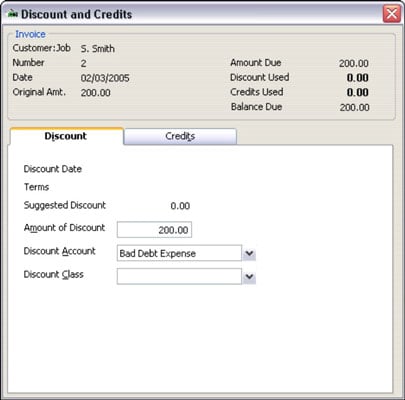
In QuickBooks, you record bad debts on the Discount and Credits page, which is part of the Customer Payment function.
Select Bad Debt Expense from the Discount Account menu.
Click Done and verify that the discount is applied and no payment is due (see the figure below).
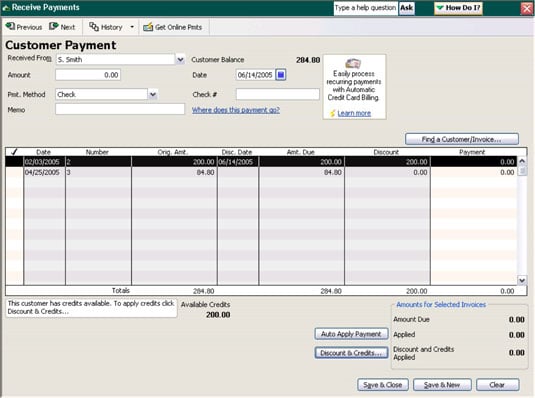
After you record a bad debt in QuickBooks, the discount appears, indicating that $0 is due.

Accounting Glossary
accounting equation
The equation Assets = Liabilities + Equity, which demonstrates the two-sided nature of accounting and is useful for explaining the concept of double-entry accounting (or double-entry bookkeeping).

Accounting Glossary
accounting period
The time period for which financial information is being tracked in a business, such as monthly, quarterly, or annually.

Accounting Glossary
accounts receivable
An account that records the amounts that customers owe to a business.

Accounting Glossary
adjusting entry
A correction made to a bookkeeping account that adjusts for accounting errors or other necessary changes at the end of the accounting period.

Accounting Glossary
cash flows
Used to describe the source or sources of cash or how cash is used.

Accounting Glossary
Chart of Accounts
A list of all the accounts used by a business, including what types of transactions go into each account.

Accounting Glossary
debit
An accounting entry that increases an asset or expense account, and decreases a liability or income account.

Accounting Glossary
dividends
A portion of a company’s profits paid by share of common stock on a quarterly or annual basis.

Accounting Glossary
FASB
Financial Accounting Standards Board. FASB is the highest-ranking authority in the private (non-government) sector of the U.S. for making pronouncements on GAAP and for keeping accounting standards up-to-date.

Accounting Glossary
Federal Unemployment Tax
In the U.S., the fund that used to be known simply as Unemployment. Employers contribute to the fund, and states also collect taxes to fill their unemployment fund reserves. (The acronym FUTA means Federal Unemployment Tax Act.)

Accounting Glossary
fidelity bonds
A type of insurance — typically carried by employers for their employees — that helps guard against theft and reduce the risk of loss.

Accounting Glossary
FIFO
First-in, first-out. A method for costs of goods sold in which a business charges out product costs to cost of goods sold expense in the chronological order in which the goods were acquired.

Accounting Glossary
fungible
Describes a product that is interchangeable and virtually indistinguishable from another product.

Accounting Glossary
General Ledger
A summary of all of a business’s accounts and transactions.

Accounting Glossary
IASB
International Accounting Standards Board. The IASB (based in London) is the main authoritative accounting standards setter outside the U.S.

Accounting Glossary
Journals
The location in which bookkeepers keep records (in chronological order) of daily company transactions.

Accounting Glossary
LIFO
Last-in, first-out. A method for costs of goods sold that selects the last item you purchased first, and then works backward until you have the total cost for the total number of units sold during the period.

Accounting Glossary
LLP
Limited liability partnership. A legal structure that state laws offer to qualified professionals in which all the partners have limited liability.

Accounting Glossary
PC
Professional corporation. A legal structure that state laws offer to qualified professionals who otherwise would have to operate as an unlimited partnership liability.

Accounting Glossary
petty cash
A cash account that businesses keep on hand for unexpected expenses.

Accounting Glossary
revenue
Monies that are collected in the process of selling a company’s goods and services.

Accounting Glossary
salvage value
The amount that an asset is worth after it has been fully depreciated.

Accounting Glossary
statement of cash flows
A financial statement that summarizes a business’s cash inflows and outflows during an accounting period.

Accounting Glossary
transactions
Economic exchanges between a business or other entity and the parties with which the entity interacts and makes deals.

Accounting Glossary
worker’s compensation insurance
A type of insurance carried by employers that covers its employees in case they are injured on the job.