

One of the new features that Facebook has rolled out to both a personal and business Page is the ability to add a Milestone to the Timeline. This means you can add a status update and date it for anytime in the past. Those of you who like to think ahead, be aware, you can’t add a Milestone to a future date!
The tips for creating engagement are the same for Milestones as they are for regular posts. In the text; try to add a question that has a simple answer, use fill in the blanks, ask for opinions, reply to every comment, and tag people that have an important connection to the Milestone. It doesn’t matter if your company is old or new, add a few Milestones and see how it adds to the overall quality of your Page.
The nice thing about a Milestone is how Facebook formats it immediately as a Highlighted post spanning the whole space left to right with a little flag icon to mark it as a special post. If you don’t want it to span the whole way you can make it span half the page, as Coca-Cola did on these two Milestones.
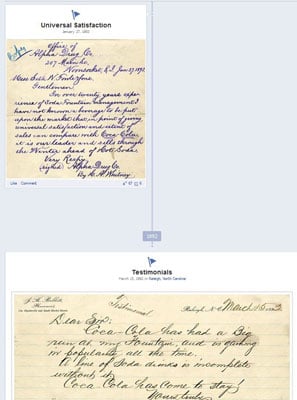
Facebook’s first required Milestone
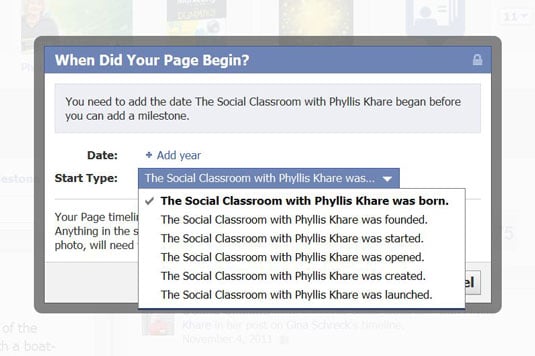
If you haven’t added a Milestone to your business page, Facebook asks that the very first Milestone is about your Page itself. They want you to post the date the business was founded, started, opened, created, or launched.
Here’s the caveat. If you are going to be adding Milestones that date back farther than when you opened the business, make the first Milestone date as far back as you can. Otherwise, if you create the first Milestone as the page launched in 2010 and then try to add a Milestone in 1990 you won’t be able to. But don’t worry; if you’ve already added your first Milestone you can edit the date to give you room to add new ones.
For this first post Facebook only gives you these verbs; founded, started, opened, created and launched. But after you’ve created this first Milestone you will not have to stick to those words. Instead you will have a field called Event where you can add your text about the Milestone.
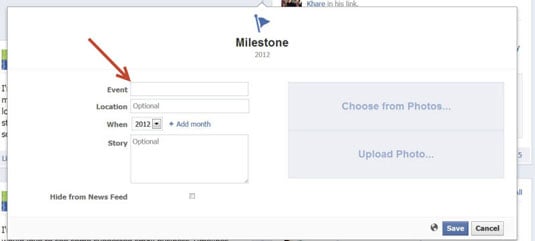
Once you have acknowledged the launch of the business, you can add as many Milestones as you want. Here are a few ideas for different types of businesses:
Product-type businesses: You can create a Milestone for the launch of each new product. Make sure you add images (or historical video) to each of these Milestones. Create a Milestone for new people added to your business, or people who have made a great contribution to your business.
Everyone uses the Coca-Cola page as a great example (and it is), as their history goes all the way back to 1886! Most small businesses I know don’t go that far back, but some started in the 50’s and 60’s. I would imagine there would a lot of Milestones that could be added. Here’s a tip: don’t add them all at the same time! Make sure you read the upcoming section about Timing Your Milestone Posts.
Service-type businesses: You can create a Milestone for each new service you created through time. For example, maybe you started out as a writer, but then became a public speaker. Add those two things to your Timeline as Milestones. Maybe your service business moved into a different building, or to a different city. Add those, too. Did you change your marketing tagline? Did you retire a service that was no longer needed (like typewriter repair…)?
Food-type businesses: This type of business probably has all the different kinds of Milestones that the product and service types would have and more! How wonderful to scan through a food business and see lots of images of food!
Timing your Milestone posts
You might be thinking to organize all your Milestones and post them all at once, but stop that thought! When you post a Milestone, it goes out as a status update to everyone connected to your Page. Imagine having 20 posts from a Page post one after another in your news feed. Multiple posts might create a little curiosity — but they also get to be a bit annoying after the tenth Milestone.
It’s great to organize what you will be posting as your historical Milestones, but think about creating a little strategy around the timing of these posts. Most research shows that people are little more attentive to Facebook on the weekends. Maybe you can spread out these posts over the next few months posting them on Saturdays, starting with the oldest to the newest, or visa versa!
If you know the exact times when your Page connections are most likely to be on Facebook, post at those times. Some businesses post right before lunch and right before dinner, as those are the times they see the most engagement.
Creating a storyline around Milestones
Create a storyline around your Milestones. In the text of the post, refer to the last Milestone you posted to keep the story going. Weave the historical with the current. In other words, as you post an historical event refer to why this event becomes something even more important in the future.
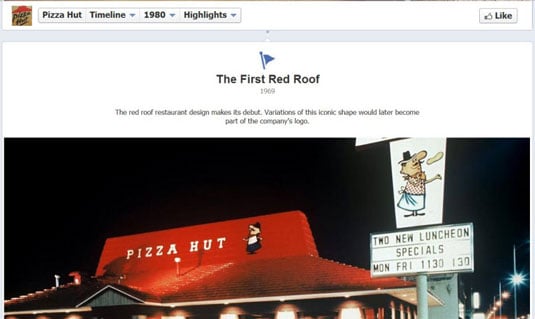
“The red roof restaurant design makes its debut. Variations of this iconic shape would later become part of the company’s logo.” -- Pizza Hut
Blogging & Social Networking Glossary
archive
1. (noun) A list of previous blog posts, in chronological order. 2. (verb) To place files or blog posts in a safer place (on DVD or another server) for longer-term or backup storage.
Blogging & Social Networking Glossary
attribute
Used in an HTML tag to give an instruction to a Web browser. For example, in This link goes to <a href="http://www.google.com">Google</a>, the <a> taggets an attribute (href) and a value ("http://www.google.com") to go along with the basic tag. In this case, the attribute indicates to the browser that what comes next is a hypertext reference — in this case, a Web page.
Blogging & Social Networking Glossary
blacklist
An often-centralized list of e-mail addresses, URLs, and IP addresses used by spammers that are then forbidden in any blog post on your blog. With an up-to-date blacklist, a lot of spam is stopped before it becomes a comment.
Blogging & Social Networking Glossary
block
To stop all contact with a MySpace user. He can’t comment on your blog page or send you any message that you actually receive.
Blogging & Social Networking Glossary
blog
A combination of the words Web and log. Bloggers (individuals, groups, or businesses) post a chronological log of information. Content is determined entirely by the author(s) of the blog; many are personal journals.
Blogging & Social Networking Glossary
blog post
An entry in a blog, possibly containing text, images, and other media.
Blogging & Social Networking Glossary
blogger
The author of a blog.
Blogging & Social Networking Glossary
blogging policy
Outlines what you’re allowed to post in your blog.
Blogging & Social Networking Glossary
blogging software
Technology that enables you to blog. Can be either hosted or nonhosted.
Blogging & Social Networking Glossary
blogroll
A collection of links used or recommended by a blogger.
Blogging & Social Networking Glossary
comment
A piece of feedback left by a reader on a blog post, or to leave such a comment.
Blogging & Social Networking Glossary
comment spam
Typically, an automated process that posts useless information with links to all kinds of other sites on your blog posts.
Blogging & Social Networking Glossary
cookie
A short piece of computer code, stored on your computer, that enables Web sites to remember certain settings and information the next time you visit that site.
Blogging & Social Networking Glossary
Dashboard
A kind of control panel in Blogger that shows you the blogs you’ve set up, giving you access posting, using help resources, or even creating another blog.
Blogging & Social Networking Glossary
definition list
A type of HTML list that gives a term and then its definition and has built-in spacing to lay out those elements properly.
Blogging & Social Networking Glossary
disk space
Amount of room available on your hard drive.
Blogging & Social Networking Glossary
domain
A domain is the address, or main URL, that people type in the browser to get to your Web site. The domain name you choose can’t be used by anyone else.
Blogging & Social Networking Glossary
domain registrar
A service that enables you to register a domain name.
Blogging & Social Networking Glossary
entry
An single posting in a blog containing text, images, or other media, or any combination of those things.
Blogging & Social Networking Glossary
Facebook
A social-networking service that enables you to keep in contact with families and friends via the Web.
Blogging & Social Networking Glossary
Flickr
A Web site that allows you to share, organize, edit, and otherwise manage your photos.
Blogging & Social Networking Glossary
Friend List
Your virtual online address book in MySpace. You can become someone’s friend by either sending a fellow MySpacer a Friend Request or by being on the receiving end of a Friend Request from another MySpace user.
Blogging & Social Networking Glossary
hosted services
Manages the data, software, and Web hosting of a blog; the blogger just manages the content.
Blogging & Social Networking Glossary
HTML
The computer coding used by Web designers to create Web pages.
Blogging & Social Networking Glossary
hyperlink
A navigation tool that allows a user to go from one Web location to another by clicking. Hyperinks (or just links) are typically underlined.
Blogging & Social Networking Glossary
hypertext reference
In HTML, the address that a hyperlink connects to when clicked. For example, in This link goes to <a href="http://www.google.com">Google</a>, the hypertext reference (href) is http://www.google.com. Hyperlink references can also jump to new positions on the same page, open a new e-mail message, or begin a file download.
Blogging & Social Networking Glossary
link
Short for hyperlink, a navigation tool that allows a user to go from one Web location to another by clicking. Links are typically underlined.
Blogging & Social Networking Glossary
Mom test
A self-test that flags inappropriate blog posts. If you’d let your mom read the post, then it’s probably passed the Mom test. Specifically, don’t blog about topics you think will hurt others; don’t blog about others without their permission, even about topics you consider inconsequential; and don’t identify friends and lovers by name without their permission.
Blogging & Social Networking Glossary
MySpace
A social-networking service that enables you to keep in contact with families and friends via the Web.
Blogging & Social Networking Glossary
MySpace profile
Your MySpace identity. It can contain as much or as little information about you as you’d like.
Blogging & Social Networking Glossary
news aggregation
The ability to aggregate news by using RSS feeds. Having a news aggregator included with your blog package allows your site to pull in information from another blog.
Blogging & Social Networking Glossary
nonhosted service
Blog software that you set up on your own Web server. It allows you to take on all responsibilities related to maintaining your blog.
Blogging & Social Networking Glossary
ordered list
Contains items that must be listed in a particular order, such as a list of ranks or preferences. It may also indicate a list of steps for the reader to follow.
Blogging & Social Networking Glossary
pinging
An automated notification system for search engines and newsreaders, letting those services know that your blog has been updated. A ping occurs when one computer asks another whether it’s there; the second computer confirms its presence.
Blogging & Social Networking Glossary
post
1. (noun) An entry in a blog containing text, images, other media, or any combination of these. 2. (verb) The act of creating and/or uploading a blog entry.
Blogging & Social Networking Glossary
private profile
A MySpace profile that’s limited on who can view it, such as only people on your Friend List.
Blogging & Social Networking Glossary
public domain
The status of publications, processes, and product designs that are free from copyrights and/or patents and are available for anyone's use.
Blogging & Social Networking Glossary
RSS feed
Really Simple Syndication. An RSS feed is a computer-readable version of your blog, standardized so that it can be displayed in newsreaders and on Web sites and blogs.
Blogging & Social Networking Glossary
sidebar
A column to the right or left of the main content of a blog that contains things like navigational links, special highlighting graphics that point to social networking sites, blogrolls, archive links, or anything that you want to share with your visitors outside the context of a blog post. Sidebars are usually included on every page of your blog and are consistent from page to page.
Blogging & Social Networking Glossary
social network
A service, such as Facebook or MySpace, that enables to keep in touch with people you know — and meet people you don’t know.
Blogging & Social Networking Glossary
spam
Unsolicited electronic messages sent in bulk that may be commercial, nonsensical, or malicious. In addition to e-mail spam, blog comments and blog forums can be targeted by spammers.
Blogging & Social Networking Glossary
tag
A relevant keyword associated or assigned to a piece of information, such as an image, a blog entry, or a video clip. Tags are usually chosen informally by the content creator or by the online community; they help give content to nontext media and organize information for ease of searching.
Blogging & Social Networking Glossary
Trackback
A technology that tracks references to a blog posting that occurs on other blogs. They allow bloggers to link to blog posts on related topics.
Blogging & Social Networking Glossary
transparent
1. Being honest and truthful on your blog. Also means that you admit mistakes and engage in dialogue with readers who leave comments. Considered proper blogging etiquette. 2. Integration of applications, programs, and media from different sources in such a way that the end user is unaware that the content is not self-contained.
Blogging & Social Networking Glossary
unordered list
unordered list is a series of bulleted items and is used for lists that don’t require numbering.
Blogging & Social Networking Glossary
video blog
A blog consisting of video files, or the practice of placing a video file in a blog post.
Blogging & Social Networking Glossary
video-sharing service
A service, such as YouTube, that enables you to share video with others.
Blogging & Social Networking Glossary
Web host
The Web server where you software, graphics, and other files live online.
Blogging & Social Networking Glossary
Web server
Technology that looks at what Web page is requested and then feeds the browser the appropriate file. It does most of the hard work of serving Web pages to visitors coming to your Web site.
Blogging & Social Networking Glossary
whitelist
A list of preselected users who are allowed to comment on your blog.
Blogging & Social Networking Glossary
YouTube
A video-sharing service.
Facebook Marketing: 9 Good Ideas for Your Business