

 Main Menu
Book & Article Categories
- Main Menu
Book & Article Categories
- Main Menu
Collections
Explore all collections

Articles & Books From John C. Shovic
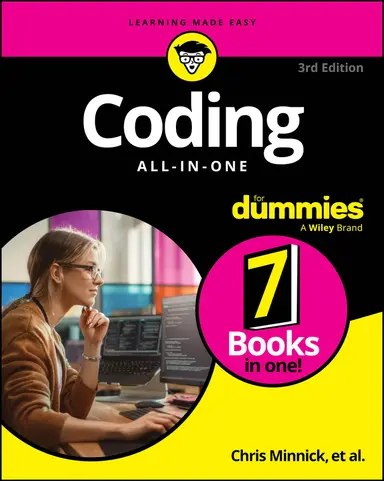
Learn to code from the basics to Python and beyond. Coding is one of the most valuable skills you can pick up, whether you're switching careers, building a side project, or just curious about how software works. Coding All-in-One For Dummies gives you a friendly, accessible introduction to the languages and tools that power the web and more — including HTML, CSS, JavaScript, Python, and AI-powered coding platforms — all in one handy volume.
Cheat Sheet / Updated 08-28-2026
Generative AI coding tools can improve your productivity as a coder, remind you about syntax, and even help you with testing, debugging, refactoring, and documentation, but it's up to you to know how to use them correctly. Get ten prompt engineering tips that can make the difference between AI spitting out garbage spaghetti code and crafting elegant code that works.
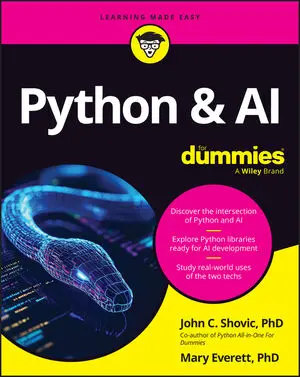
Unlock the combined power of Python and AI to supercharge your next technical project and your careerPython & AI For Dummies explores the exciting combo of two revolutionary technologies that are reshaping how we work, code, and solve problems. Authors John C. Shovic and Mary Everett draw on their extensive work in computer science, precision agriculture, and artificial intelligence to walk you through the intersection of Python programming and AI applications.
/ Updated 07-17-2026
Artificial intelligence has taken the world by storm, and Python is the standout language used in AI development. This cheat sheet is designed to give you an overview of the different types of artificial intelligence models and how they can be implemented in Python for various tasks. Understanding the types of artificial intelligence It’s tempting to think of AI as one type of model (your typical chatbot, for example), but AI model types are many and numerous.

The no-nonsense way to get started coding in the Python programming language Python Essentials For Dummies is a quick reference to all the core concepts in Python, the multifaceted general-purpose language used for everything from building websites to creating apps. This book gets right to the point, with no excess review, wordy explanations, or fluff, making it perfect as a desk reference on the job or as a brush-up as you expand your skills in related areas.
Cheat Sheet / Updated 04-12-2024
Python is a flexible programming language that has become increasingly popular in the past few years. This cheat sheet is designed to give you a handy resource for common Python data types, Python operators, and Python functions. It includes Python data types, operators, special characters, f-strings, and functions for working with robots.
Article / Updated 07-10-2023
Before you can get going here, make sure you have your Raspberry Pi computer set up and running on your monitor, keyboard, and mouse. If not, go do that now The next few paragraphs are going to be lots more fun with a computer to work with!The Raspberry Pi is the perfect platform to do physical computing with Python because it has a multiscreen environment, lots of RAM and storage to play with and all the tools to build fun projects.
Article / Updated 01-25-2022
For all the hoopla about Python modules, a module is actually a pretty simple thing. In fact, a Python module is just a file with a .py extension that contains Python code. That’s it. So any time you write Python code and save it in a .py file, you’ve basically created a module.That’s not to say you always have to use that code as a module.

Everything you need to know to get into Python coding, with 7 books in one Python All-in-One For Dummies is your one-stop source for answers to all your Python questions. From creating apps to building complex web sites to sorting big data, Python provides a way to get the work done. This book is great as a starting point for those new to coding, and it also makes a perfect reference for experienced coders looking for more than the basics.
Article / Updated 08-05-2020
The first thing to know about I2C is that every device on the I2C bus has an address. For example, an HDC1080 temperature and humidity sensor that you can easily make has an address of 0x40. What does the “0x” mean in this address? It means that the number that follows is in hexadecimal notation, base 16 instead of base 10 (our normal numbering system).

